
The last three prime ministers who served full terms started out in their early 70s. Mr Modi is younger and fitter than all of them. But he needs to find it in him to change course if he is to beat the odds, notes T N Ninan.

Taking on board India's concerns, the G-20 Summit on Friday acknowledged that excess volatility of financial flows and disorderly movements in exchange rates can affect economic and financial stability of emerging markets and called for sound policies to address it.

Don't waste the money on politically motivated social programmes.

The central bank and Indian government has reached a "broad consensus" on the composition of a rate-setting panel.

There has been a welcome focus on fundamental reforms, time-bound programmes that fix accountability and the use of technology. The upcoming Budget could build on these initiatives, says Abhas Jha.

May be the strong United States growth will lead the world back to a period of growth and help us all put this painful recrimination behind us.

'It is unrealistic to expect that security dilemmas and strategic distrust to disappear or even diminish any time soon,' says Rup Narayan Das.
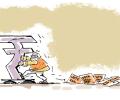
Perhaps the calculation is that economic recovery will have been achieved before the next general election comes around, but such assumptions can come unstuck if current directions are not reversed quickly, cautions T N Ninan.

'China could place the currency on a par with global biggies. But it has to wait to be a serious challenger.'

Will Greece manage to pay euro 1.5 billion to IMF?

Recent IMF forecast said China's growth is expected to slow down.

Thinking big, China is changing the world order; with mixed priorities, we can but tag along, writes T J S George.

A day after BRICS (Brazil, Russia, India, China and South Africa) nations agreed on a $100-billion foreign currency reserve pool to tackle the volatile foreign exchange markets, India on Friday said the pool would act as a buffer arrangement, adding it might not withdraw anything from this reserve.

The RBI on Friday imposed a fine of Rs 6.5 crore (Rs 65 million) on six public sector banks including IDBI Bank, Dena Bank and Indian Bank, for violation of customer identification or KYC norms and anti-money laundering guidelines.

If banks have a surplus, they have the option of parking the money with the RBI.

He said the short term macroeconomic priorities of the RBI continue to focus on bringing down inflation towards the government-set target of 4 per cent

While naysayers say the economy is on a downward spiral, optimists point out that India has experienced a shift of gears in the realm of policies, thanks to several initiatives of the Narendra Modi government, says Ashok K Lahiri.
.jpg)
The repo rate continues to be at 8 per cent while the cash reserve ratio has also been retained at 4 per cent despite inflation based on the Wholesale Price Index coming down to a 5-year low of 1.77 per cent in October.

None of the four benchmarks suggested by the RBI is ideal as banks in India create loan assets from their deposits and not borrowing from the regulator or market, says Tamal Bandyopadhyay.

The panel will also recommend a fiscal consolidation road map for the central and state governments, study the impact of GST on the divisible pool, and propose performance-based incentives for states.

Financials were among the top losers along with Sun Pharma and index heavyweight Reliance Industries

'That is not a democratic ideal obviously, but it is a practical reality.' 'It is a consistent feature of politicians in Pakistan that their rhetoric on the army softens the closer they get to the seat of power.'

'Mostly, the relief, if needed, would be for housing loans where a person has lost a job and is unable to pay his EMI or there has been a temporary salary cut.'

Traditionally, financial institutions have operated risk functions in silos. However, the nature of unknown threats today requires industry participants to work together, says Vikram Limaye.

India still has to go a long way to implement reforms in various sectors.

It is a wonder how pervasive and long-lasting the damage can be from a balance-sheet crisis, says Suman Bery.

Panagariya has advocated a more liberalised spending, arguing that greater capital expenditure could relax some of the infrastructure bottlenecks facing the country.

Here are the key decisions announced by the Reserve Bank of India on Thursday.

Their reopening followed Prime Minister Alexis Tsipras' reluctant acceptance of a tough package of bailout demands from European partners

Prime Minister Alexis Tsipras battled to win lawmakers' approval on Wednesday for a bailout deal to keep Greece in the euro and avoid bankruptcy, as the IMF pressured Greece's creditors to provide massive debt relief for its crippled economy.

We are in this mess as the machinery of the government in a market economy is broken. We need technically sound banking regulation, so that capital is not misallocated, and the landscape does not get littered with zombie firms kept alive through evergreening, says Ajay Shah.

From NITI Aayog to industry leaders to the Reserve Bank of India, all are apprehensive that any major increase in MSP, following the 2018-19 Budget announcements, would push up prices, if not immediately, in the next six to eight months after the decision is taken.
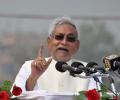
Bihar became the first non-NDA state and overall second after the BJP-ruled Assam to pass GST bill.

Substantial gains can still be made with good policies and initiatives.

One has to wonder what is so wrong with the European Union.

One incident should not be used to generalise the health of all cooperative banks, says RBI governor Shaktikanta Das.

China's intended role for AIIB is not so different from the existing Western lenders like the World Bank.

Ajit Balakrishnan on understanding the anti-cash chorus.

The evolving RBI-government relationship, a reversal in the interest rate cycle and return to profitability will dominate bankers' conversation this year, says Tamal Bandyopadhyay.

Although this may not be music to Raghuram Rajan and Viral Acharya's ears, the real reason in my estimation for their quitting is expatriate over-sensitivity, intolerance or arrogance, argues B S Raghavan, the distinguished civil servant.
 © 2026 Rediff.com - Advertise with us - Disclaimer - Privacy Policy - Sitemap - Feedback - About us - Terms of use - Grievances